America at 250: The Great Experiment Continues
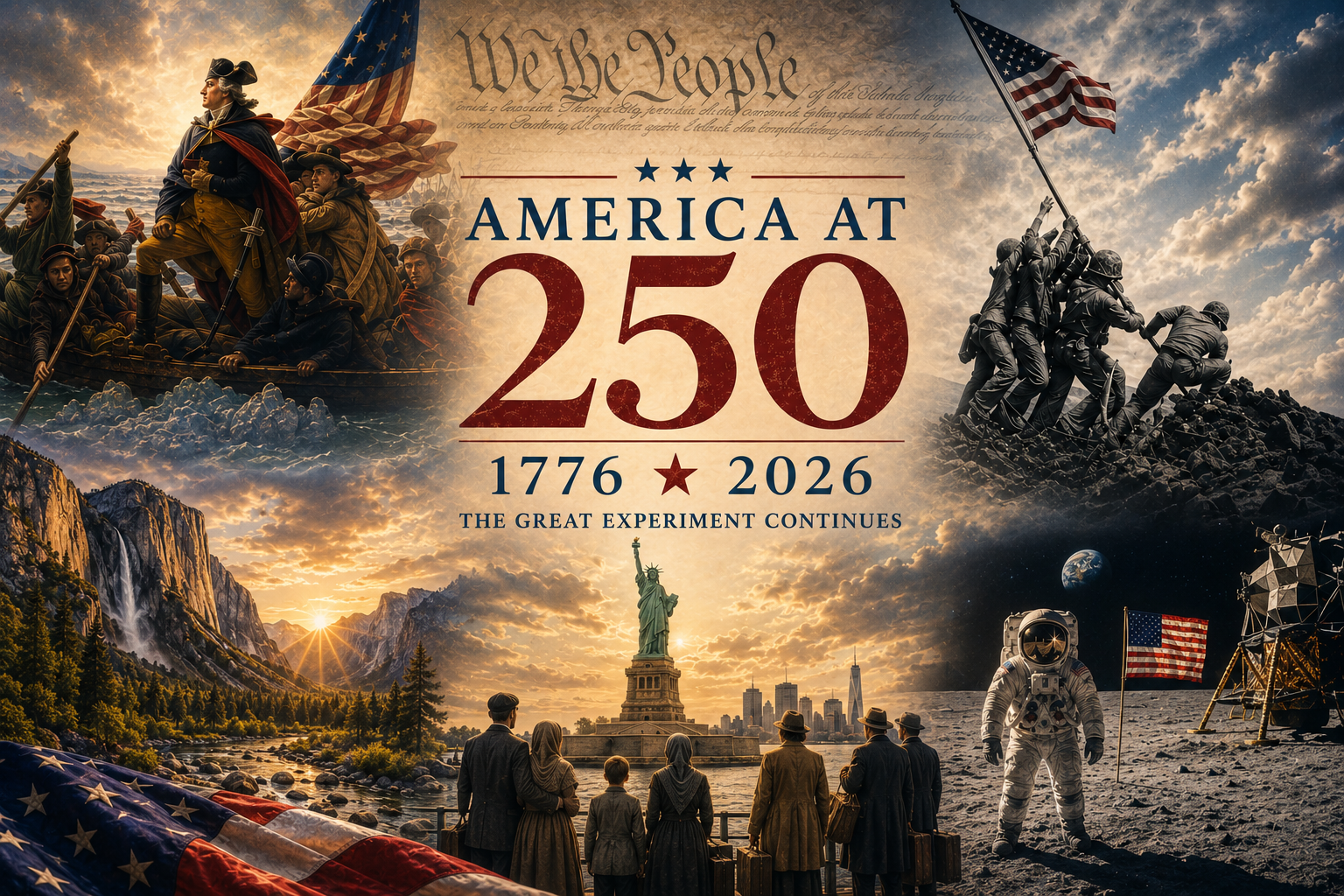
On July 4, 2026, the United States of America celebrated a milestone no other nation has ever commemorated in quite the same way: the 250th anniversary of an idea. Not the anniversary of a king’s coronation, not the founding of a dynasty, not the conquest of a continent. The anniversary of an extraordinary proposition, that ordinary people could govern themselves, that liberty belonged to every individual rather than being granted by rulers, and that a nation could be built not upon bloodlines, ethnicity, or religion, but upon a shared commitment to enduring principles. For 250 years, that proposition has been tested by civil and world wars, by economic upheaval and political division, by extraordinary triumphs and painful failures. Yet through it all, the American experiment has endured.
Anniversaries invite perspective. In an age dominated by twenty-four-hour news cycles, social media outrage, and political polarization, it is easy to lose sight of the larger arc of history. Every generation has witnessed moments of disappointment and uncertainty, and every generation has wrestled with questions about whether the nation was living up to its ideals. Yet stepping back from the passions of the moment reveals something remarkable: despite its flaws, contradictions, and unfinished work, the United States remains one of the most successful and influential experiments in human history.
No nation has ever been perfect. Every civilization has struggled with injustice, conflict, inequality, and hypocrisy. The question is not whether America has always been flawless, the question is whether any nation has done more over the past two and a half centuries to advance the ideals of liberty, self-government, opportunity, and human dignity. Viewed through that lens, the American story stands apart.
A Nation Founded on an Idea
For most of recorded history, the ordinary person had little control over the course of his or her own life. Kings inherited crowns, emperors conquered kingdoms, and aristocracies preserved power through bloodlines and privilege. Governments existed to serve rulers rather than the ruled, and individual rights were generally viewed as privileges to be granted or withdrawn by those in authority. While republics and democracies had appeared briefly in earlier civilizations, they were often fragile, limited in scope, or ultimately consumed by more powerful empires. Against that backdrop, thirteen British colonies on the eastern edge of North America proposed something astonishing: that legitimate government derived its authority not from a monarch, but from the consent of the governed.
The Declaration of Independence announced that revolutionary idea to the world. Its words have become so familiar that it is easy to overlook how radical they were in 1776. The assertion that all people are created equal and endowed with certain unalienable rights challenged centuries of accepted political thought. The Constitution transformed those ideals into a durable framework for self-government, while the Bill of Rights protected freedoms of speech, religion, the press, assembly, and due process in ways that were virtually unprecedented. These documents became the operating system of a new kind of nation, one in which government existed to protect liberty rather than bestow it.
Those ideals, however, were imperfectly applied from the very beginning. Slavery stood in direct contradiction to the Declaration’s promise of equality. Women were excluded from political participation. Native American nations were crushed as the nation expanded westward. Yet embedded within the nation’s founding principles was the ability to challenge the nation itself. Abolitionists, suffragists, and civil rights leaders all appealed to America’s founding ideals, arguing not that they were wrong, but that they had not yet been fully realized. The genius of the American experiment was that it gave every generation the freedom and responsibility to move the nation closer to its aspirations.
Democracy’s Expanding Circle
If liberty was America’s founding principle, democracy became its greatest work in progress. The republic established in 1789 was revolutionary for its time, but it was also incomplete. Political participation was limited, millions remained enslaved, women were excluded from the ballot box, and many others found themselves outside the full protections promised by the nation’s founding documents. Those realities represent the beginning of the American story, not its conclusion.
One of the distinguishing characteristics of the United States has been its remarkable capacity for self-correction. Constitutional amendments abolished slavery, guaranteed equal protection under the law, and expanded voting rights. The long struggle for women’s suffrage culminated in the Nineteenth Amendment. The Civil Rights Movement challenged segregation and dismantled legal barriers that had denied millions of Americans their full citizenship. None of these victories came easily, but each reflected the enduring belief that America should become more faithful to its founding ideals.
The path was neither straight nor smooth. Reconstruction gave way to Jim Crow. Waves of anti-immigrant sentiment produced exclusionary laws. The Red Scare demonstrated how fear and suspicion can threaten the very freedoms they claim to protect. Yet again and again, democratic institutions and ordinary citizens proved stronger than the forces of division, and over time, the nation continued moving closer to the principles upon which it was founded. Democracy in America has never been a finished product, it has always been an ongoing act of citizenship.
From Every Corner of the Earth
Perhaps no achievement better illustrates the success of the American experiment than its ability to transform people from every corner of the globe into one nation. Throughout history, most countries have defined themselves by ancestry, language, religion, or ethnicity. America invited people not to share a common ancestry, but to embrace a common ideal. To become an American was not to abandon one’s past, but to join a shared future.
Every great wave of immigration has been met with both hope and anxiety. The Irish, Italians, Chinese, Jews, Eastern Europeans, Japanese, Vietnamese, Indians, Africans, Hispanics, and countless others all encountered moments when they were told they were somehow different or incapable of becoming ‘real Americans.’ Looking back across history, those fears seem almost quaint. The children of yesterday’s outsiders became tomorrow’s neighbors, teachers, entrepreneurs, physicians, scientists, artists, soldiers, and politicians.
Assimilation has never required people to erase their heritage. America is better understood as a great orchestra. Every instrument retains its own distinctive voice, yet together they perform something none could create alone. Families preserve treasured traditions while embracing the civic values that unite Americans regardless of origin. Immigration has continually renewed the nation with fresh ideas, energy, and ambition. For 250 years, millions have accepted that invitation. They did not simply come to America – they became America.
The Beacon and the Mirror
From the moment of its founding, the United States attracted the attention of the world. America’s greatest influence has never rested solely upon its wealth or military strength, it has rested upon the enduring appeal of its ideals. For generations, people living under tyranny looked toward the United States not because Americans were perfect, but because freedom seemed possible.
During the defining struggles of the twentieth century, the United States became more than a nation, it became a symbol that free societies could endure. Refugees crossed oceans seeking liberties unavailable at home. Reformers around the world drew inspiration from the idea that governments exist to serve their citizens rather than the other way around.
Like every great power, America has sometimes fallen short of its own aspirations. There were moments when strategic interests overshadowed ideals and interventions abroad stood uneasily beside commitments to self-determination. Yet those decisions were debated openly by the American people themselves. That willingness to examine our own failures, argue about them, and strive to do better is itself a hallmark of a free society. America has often been a mirror, reflecting both humanity’s highest aspirations and its deepest contradictions. It has remained a beacon because those aspirations have continued to burn brighter.
The Experiment Continues
As Americans celebrate the nation’s 250th birthday, this anniversary is not the culmination of a remarkable journey but a milestone along a road that stretches beyond any one generation. The founders launched an experiment whose outcome they could never know. Every generation since has inherited that experiment, strengthened it in its own way, and entrusted it to those who followed.
The American story has never been a straight line. We have expanded freedom while at times denying it, we have welcomed newcomers while often demonizing them, we have championed equality while struggling to achieve it. Yet through every contradiction runs an enduring belief that tomorrow can be better than today, and that ordinary citizens possess both the right and the responsibility to help make it so.
That belief has shaped every chapter of our history. Soldiers preserved the Union, abolitionists confronted slavery, suffragists expanded democracy, civil rights leaders challenged the nation to honor its promises, and immigrants renewed its energy. Entrepreneurs, scientists, teachers, artists, first responders, and millions of ordinary Americans strengthened the republic through lives of service and purpose. The American experiment has never depended solely upon extraordinary leaders, it has depended upon ordinary Americans doing extraordinary things together.
America’s exceptionalism has never rested upon a claim of perfection. It has rested upon the conviction that free people, united by enduring ideals, are capable of continual improvement. Every generation has inherited an unfinished republic and has been called to leave it stronger than it found it.
As we celebrate this historic anniversary, we should do so with both gratitude and humility – gratitude for those who began this remarkable experiment and for every generation that sacrificed to preserve it, humility because we know the work is not finished. Liberty must be protected, democracy must be renewed, and opportunity must be expanded. For 250 years, Americans have inherited the Great Experiment from those who came before them. Our generation now holds that same privilege. We cannot rewrite the past, we can only learn from it, preserve what is worthy, correct what is not, and leave the republic stronger than we found it.
That is the enduring promise of America. That is the responsibility of every American. And that is why, after 250 remarkable years, the Great Experiment continues.

Related Posts

The Arts as a Bridge Between People and Planet
In Defense of Immigration: The Secret to 250 Years of American Greatness

Japan/Thailand March 2025
Nature In All Its Glory!